





















Preschool, Daycare or K-12 School Franchise: Matching the Education Model to Your Budget
Preschool, daycare or K-12 school franchise? A budget-led comparison of investment, time to open, payback and owner workload to help investors choose the right education model.


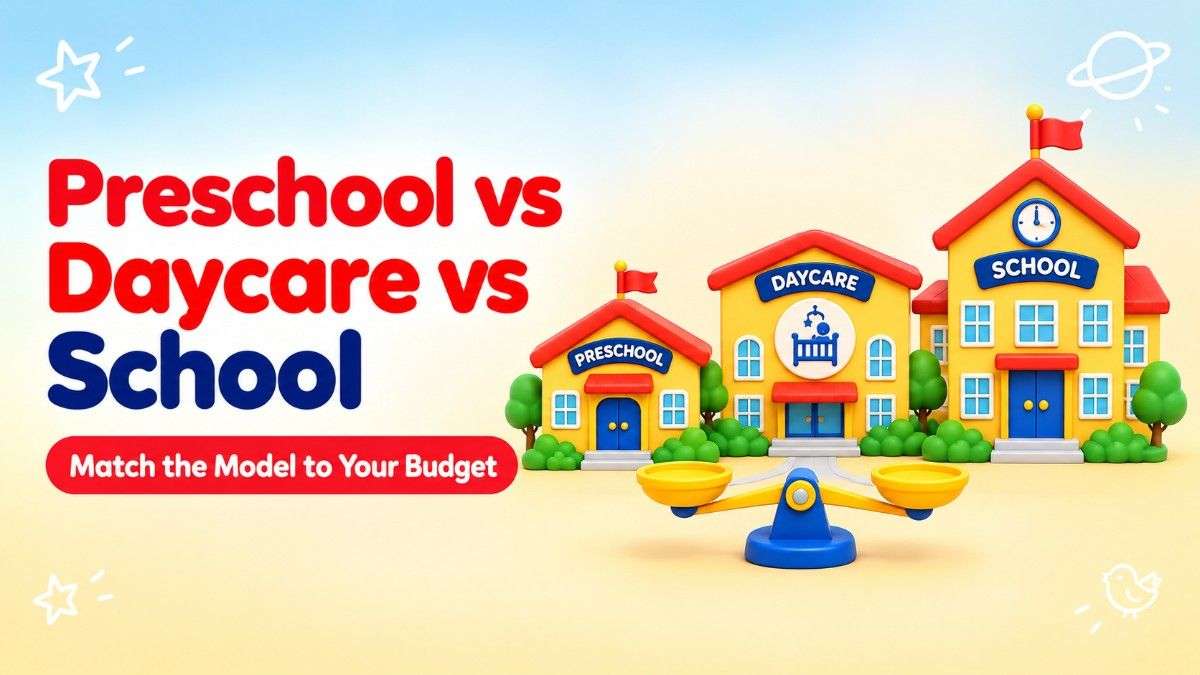

If your budget is under 30 lakh rupees, a preschool franchise, with or without a daycare wing, is the realistic education franchise. A K-12 school franchise usually needs several crores, land or a long lease on a large building, and one to three years of approvals and construction before the first student arrives. Daycare sits between the two in workload but close to preschool in cost. This article compares the three models by budget band, time to open, regulatory weight and owner involvement, so you can see which one your money and time actually fit.
How do preschool, daycare and K-12 school franchises differ?
They differ in age group, hours, capital, approvals and how long the money takes to come back, with the school model being an order of magnitude larger on every count.
A preschool serves children of roughly two to six years for a few hours each morning, in playgroup, nursery and kindergarten classes. A daycare serves infants to school-age children for longer hours, often until evening, and is closer to a care service than a teaching programme. A K-12 school runs formal classes from primary to senior secondary under a board such as CBSE, ICSE or a state board.
|
Point of comparison |
Preschool franchise |
Daycare (standalone or add-on) |
K-12 school franchise |
|
Typical setup budget |
About 8 to 30 lakh rupees |
Often 5 to 20 lakh, lower as an add-on |
Usually several crores |
|
Space needed |
Ground floor, about 1,500 to 3,000 sq ft |
Similar, plus rest and feeding areas |
Large campus or building, land often needed |
|
Time to open |
3 to 6 months |
2 to 4 months |
1 to 3 years |
|
Approvals |
Local registration, safety and building norms, which vary by state |
Similar, with extra care norms in some states |
Board affiliation, land and building approvals, state recognition |
|
Owner involvement |
Daily, hands-on |
Daily, long hours |
Management team, governing body |
Which model fits a budget under 30 lakh rupees?
A preschool franchise, ideally with a daycare wing added once mornings are full, because it uses the same building for more hours of the day.
At this budget, a school is not an option. The decision is really between a preschool alone and a preschool with daycare. Many owners start with preschool hours, then add afternoon daycare once they know which parents need it. The building, staff relationships and parent trust are already in place, so the extra revenue comes without a second rent.
Daycare changes the workload. Hours stretch to the evening, meals and naps need supervision, and staffing must cover longer shifts. It suits owners who have a reliable centre head or who can be present for longer days.
What about budgets between 30 lakh and 1 crore rupees?
This range usually funds a larger flagship preschool or two centres, not a school, and the second centre is often the stronger use of the money.
A bigger budget is tempting to spend on a grander first centre. But a preschool earns from occupancy, not floor area. A second, well-located centre a few kilometres away doubles the catchment, and lessons from the first centre lower the risk of the second.
Some investors in this band look at a small CBSE or state-board primary school. In most cities, land and building requirements put that beyond the band once construction and approvals are counted. Check the current norms for your state and board before spending on a feasibility study.
When does a K-12 school franchise make sense?
When you have several crores, access to suitable land, the patience for a long build-out, and the ability to employ a professional principal and management team.
A school is an institution rather than a small business. Fee collection is larger and steadier over many years, and a good school can become a local landmark. But the capital is locked in for a long time, the approval path is long, and the returns depend on filling many classes across many grades.
Many school operators actually begin with a preschool. A preschool builds a parent base and a local name with far less capital. That is one reason established preschool networks, such as Shanti Juniors with a reported 350 plus centres across 74 plus cities, are often a first step for education entrepreneurs who later expand into larger formats.
How do payback and risk compare across the three?
Preschools usually reach monthly break-even in 18 to 30 months, daycare can be faster as an add-on, and schools typically take several years to recover capital.
Industry reports place mature preschool operating margins at around 20 to 35 percent, with break-even commonly between 18 and 30 months depending on occupancy, fees and rent. A daycare wing added to a running preschool can contribute sooner, because it shares fixed costs that are already paid.
School economics are different. The capital is much larger, and the early years carry heavy fixed costs before senior classes fill. Risk is also more concentrated: a single location decision, a delayed approval or a weak first principal can affect the investment for a decade.
How do you decide which model to choose?
Start from your budget, then your time, then your appetite for regulation, and choose the smallest model that matches your ambition.
-
If your total funds, including working capital, are under 30 lakh rupees, choose a preschool franchise.
-
If you or a trusted manager can cover long hours, plan a daycare wing for year two.
-
If you have 30 lakh to 1 crore rupees, consider two preschool centres before one large one.
-
If you have several crores and land, a school may fit, but study the preschool route as a first step.
-
If you want passive income, none of the three is passive, and education rewards presence.
The brand's guide to preschool franchise options in India is useful background on formats within the preschool model itself.
Frequently asked questions
Preschool franchise vs school franchise, which is better?
For budgets under about 1 crore rupees, a preschool franchise is the practical choice. A school franchise suits investors with several crores, land and a long time horizon.
Can I add daycare to a preschool franchise?
Often yes, subject to the franchisor's approval and local norms. Many owners add afternoon daycare once morning preschool classes are full.
How long does a school franchise take to open?
Usually one to three years, including land or building, construction or fit-out, and board affiliation and state approvals.
Which model has the fastest payback?
A daycare wing added to a running preschool is usually fastest, because it shares rent and staff. A standalone preschool commonly breaks even in 18 to 30 months.
Is a preschool a good first step towards a school?
Yes, for many investors. It builds a parent base, local reputation and operating experience with much less capital at risk.
Author Bio
Written by an independent education-sector analyst who studies India's early-education franchise market, including brands such as EuroKids, Kidzee, Little Millennium and Shanti Juniors.
What's Your Reaction?
 Like
0
 Dislike
0
 Love
0
 Funny
0
 Angry
0
 Sad
0
 Wow
0


